









Two days before my master’s recital, I was in a lesson with my teacher.
She kept coming back to the same rhythm in one of the passages—hounding me on it, as teachers do. I thought I had done everything right. I had spent so many hours practicing it. I had repeated it countless times, and it felt solid in the practice room.
But standing there, I had a panic moment.
My recital was in two days. And I suddenly realized I wasn’t prepared—not in the way I thought I was and not the way I should have been for a Master’s recital.
The passage I had spent so much time on wasn’t holding up under the mild pressure of a lesson. In performance, I’d only get one try. And when that moment came on recital day, those challenging passages I had painstakingly practiced turned to mush.
For a long time after that, I blamed myself. I told myself I just hadn’t practiced enough, or that I wasn’t mentally tough enough. But eventually I realized the problem wasn’t effort.
It was my practice.
I had never been taught how to practice. And like most musicians, I filled that gap with the only method I knew: repeat it until you get it right.
That approach feels productive. It’s what most of us absorbed growing up—from practice room culture, from well-meaning teachers who didn’t have time to explain the mechanics, and from the simple logic that more repetition equals more learning.
But that logic has a flaw.
The problem isn’t repetition itself. The problem is how and when it’s used. And understanding that distinction can completely change how you approach the practice room.
Before we dive in—if you’ve ever walked out of a practice session feeling like you nailed something, only to have it fall apart later, my free Practice Audit Checklist is worth a look. It’s 60+ questions designed to help you evaluate whether your practice habits are building real reliability — or just the illusion of progress.
The Brain Reinforces What You Repeat—Not What You Intend
Here’s what no one tells you about repetition: The part of your brain that executes a passage doesn’t know the right notes from the wrong ones.
It can’t evaluate your attempts and reward the good ones. It simply strengthens whatever notes you repeat most often.
Think of it like the Grand Canyon. Water doesn’t carve a path through rock because it’s the right path. It carves it because it’s the most traveled one. With enough repetition, that groove becomes deeper and deeper until it’s the only route the water naturally takes.
Your neural pathways work the same way. Every time you play a passage, your brain is building what I think of as an execution plan—a stored map of exactly how to play that passage. The problem is, it doesn’t flag whether the map leads somewhere good. It just stores what you repeatedly do, right notes or wrong ones.
And once that execution plan is stored, it’s remarkably durable. You can come back to a piece ten years later as a much better musician and still make the same mistake —because your brain is running the old execution plan.
Under pressure, your brain doesn’t pause to choose the best option. It defaults to what it knows best, the most deeply carved pathway. Which means if the incorrect version has been repeated more than the correct one, that’s what comes out when the stakes are high.
(If you want to go deeper on the neuroscience behind this, I cover it in more detail in How to Practice Difficult Passages Effectively.)
The Probability Problem
This is where repetition gets mathematically tricky—and where a common piece of practice advice quietly breaks down.
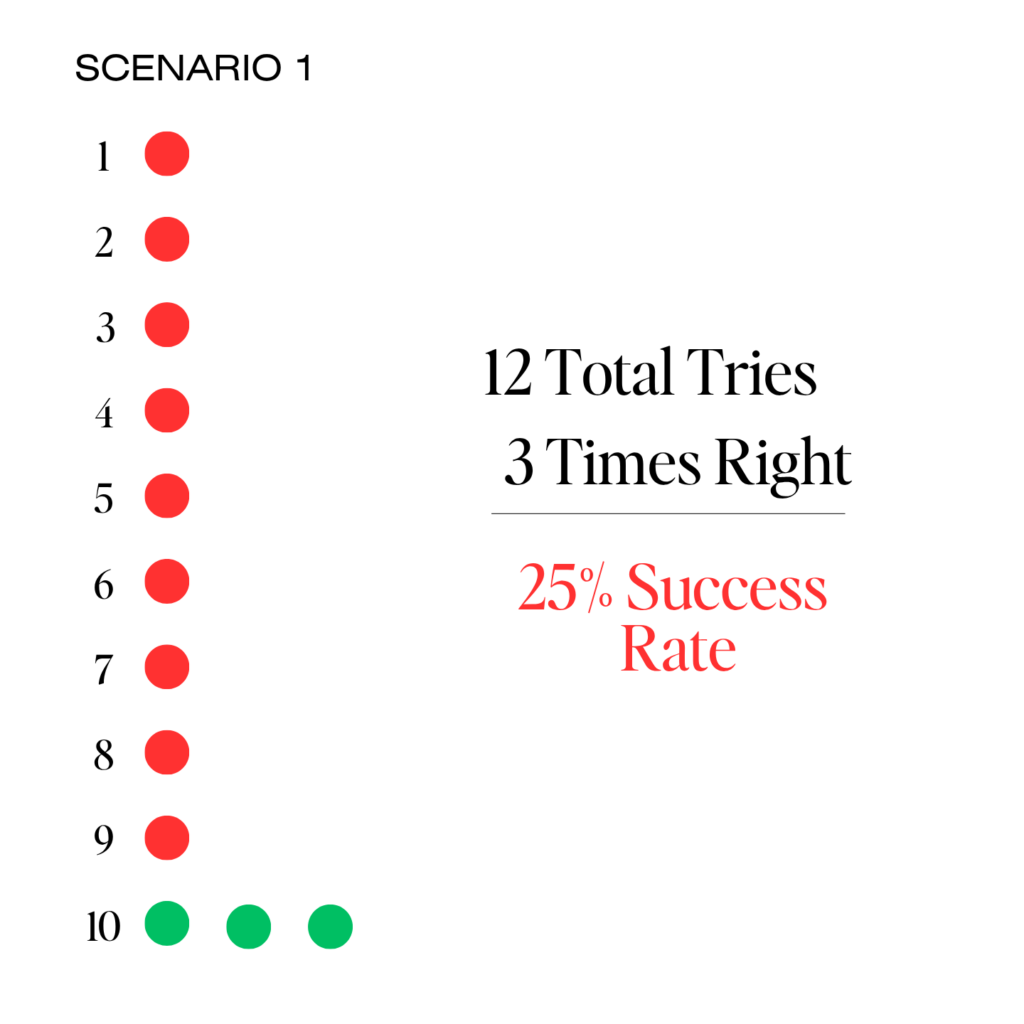
You may have heard the rule: get it right three times in a row before moving on. It sounds reasonable. But let’s look at what actually happens.
Scenario 1
It takes you 10 tries to get your first clean streak of three. You played it incorrectly 9 times before nailing it 3 times in a row. That’s 12 total attempts, 3 correct. You’re getting it right only 25% of the time. But because you ended on a clean streak, it feels like progress.
Scenario 2
You’re alternating—one correct, one incorrect—nine times through, then you land three in a row to finish. That’s 21 total attempts, 12 correct. You’re succeeding 57% of the time. Better. But your brain has still reinforced the incorrect version nearly as often as the correct one.

Scenario 3
Now you’re getting two correct before each mistake. Nine rounds of that, then three in a row to close. 30 total attempts, 21 correct. 70%. That feels pretty good in the practice room.
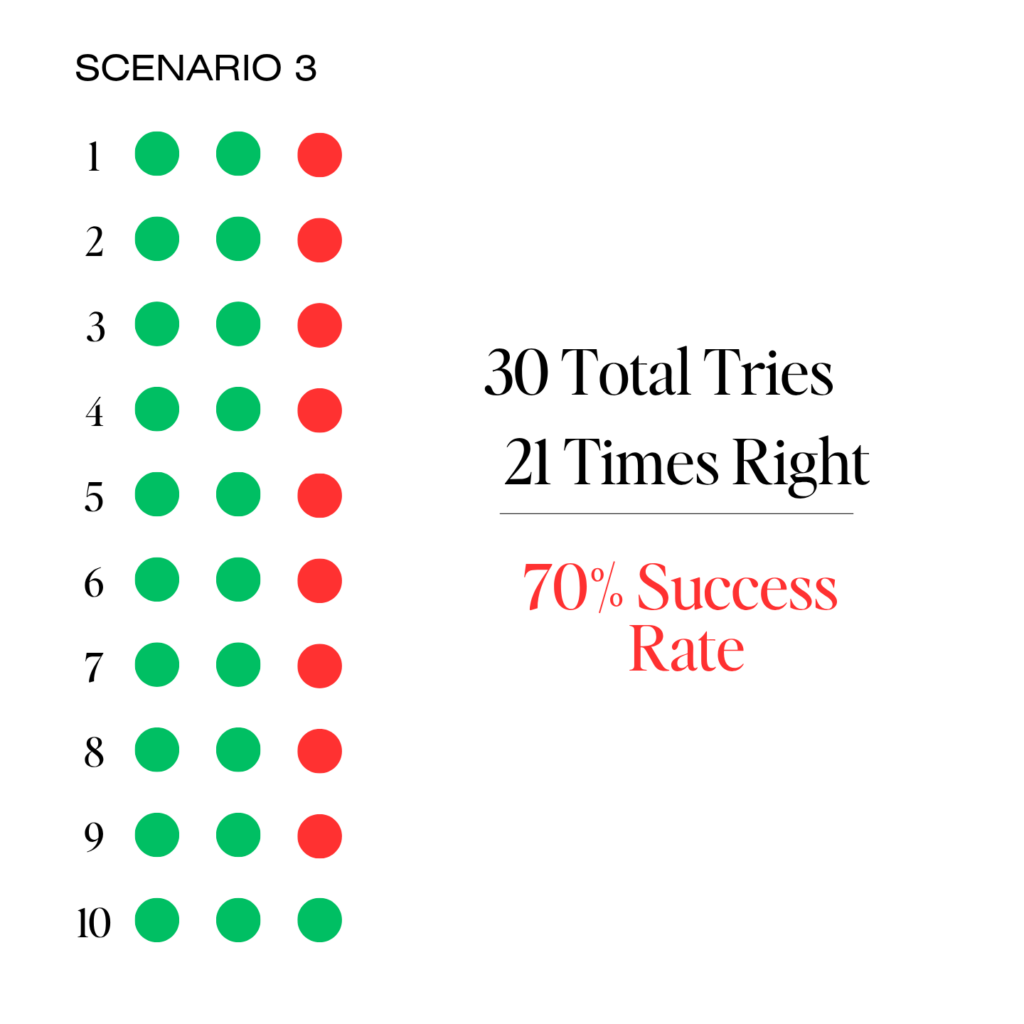
But here’s the problem: 70% means roughly 1 in 3 attempts still has an error in it. And in performance, you don’t get 30 tries. You get one.
This is what I call false mastery. The clean streak at the end creates the illusion that the passage is more secure than the statistics actually show. You feel successful. But your brain has been running the incorrect execution plan far more often than you realize.Ending on three good reps doesn’t erase what came before. Every attempt—clean or not—is part of what gets reinforced. Three correct reps at the end of a 30-attempt session doesn’t mean the passage is ready. It means it worked out this time.
The Illusion of Progress
Here’s what makes this so frustrating: repetition feels like it’s working.
The more you repeat something, the more familiar it becomes and the less you have to think about it. The notes start to feel easier. Your confidence rises. By the end of a practice session, you may genuinely believe a passage is ready.
But what you’re often feeling is familiarity, not stability.
Familiarity means a passage feels comfortable under the specific conditions in which you practiced it. Stability means it holds up even when those conditions change—when you’re nervous, when you enter the passage from a different musical context, when you don’t get to warm into it three times before the real attempt.
Familiarity isn’t the same as stability.
And that distinction is exactly why passages that felt fine in the practice room can fall apart the moment the stakes get higher.
When Repetition Actually Works
None of this means repetition is bad. It means repetition has a specific job.
Repetition is most effective at the reinforcement stage—after coordination is already clear. Once you know exactly what your fingers, air, tongue, etc. need to do, repetition deepens and strengthens that pathway. That’s when it becomes a powerful tool.
The mistake most musicians make—including the version of me preparing for that master’s recital—is using repetition at the learning stage. When a passage is still unclear, when errors are still happening, when coordination hasn’t been sorted out yet, repetition isn’t reinforcing anything useful. It’s just deepening confusion.
Repetition should reinforce clarity, not compensate for confusion.
If you find yourself repeating a passage and the errors keep reappearing, that’s a signal. Not to repeat it more, but to stop, slow down, and figure out what’s actually not working.
Sometimes that means isolating a single measure. Sometimes it means dropping the tempo significantly and mapping the coordination from scratch. Sometimes it means identifying the one or two notes where everything breaks down and working only on those transitions. Once the coordination is clear, then you repeat—and now the repetition is building something solid.
What to Do Instead
So if repetition alone isn’t the answer, what is?
Reliable passages come from practicing with a different set of tools: isolating the specific coordination problems, varying entry points so the brain can’t rely on momentum, and gradually introducing performance-like conditions before you ever step on stage.
I cover these strategies in detail in How to Practice Difficult Passages Effectively—including how to combine slow and fast practice, how to find the true problem notes in a run, and how to test whether a passage is actually performance-ready.
Repetition isn’t the enemy.
But repetition without strategy leads to fragile results—passages that feel solid in the practice room and fall apart the moment the pressure rises.
When you understand that the brain reinforces whatever pathway is most traveled, repetition becomes a tool you use intentionally rather than a default you reach for when something isn’t working.
Used at the right stage, it’s incredibly powerful. Used too early, it just deepens the wrong groove.
If you’re not sure whether your current practice habits are building real reliability—or just familiarity—grab my free Practice Audit Checklist. It walks you through the key questions that reveal whether your preparation will hold up when it counts.
+ view the comments
Paragraph
Previous Post
Next Post
for when you're ready—
🎯 1. 60-Minute Strategy Session
Big performance, audition, or jury on the horizon? In this one-off intensive, we audit your current practice, map out a data-driven plan, and troubleshoot the spots that keep falling apart under pressure—so you walk away with a clear roadmap, not more question marks. Book your Strategy Session →
🔥 2. Practice Strategy Intensives
Ever wonder why your practice works… until it doesn’t? Inside Practice Strategy Intensives, we audit your current practice, map out a data-driven plan, and troubleshoot the spots that keep falling apart under pressure—so you walk away with a clear, sustainable roadmap that holds up under performance pressure. Learn more about Practice Strategy Intensives →
📚 3. The Practice Code for Musicians
Want a complete practice system instead of piecing tips together from Instagram? My signature course blends strategy, mindset, and artistry to show you exactly how to practice for confident, consistent performances—on stage, in the studio, and at the stand. Join the waitlist here →
✉️ 4. Stay in the loop (and in the practice room).
Not ready for a full commitment yet? Get weekly practice tips, mindset tools, and behind-the-scenes stories straight to your inbox—plus first dibs on new offers. Join the newsletter →
You deserve to have a musical toolkit that allows you to thrive. I combine my expertise as a professional flutist and software developer to give you a methodical, science-backed approach to learning even the most difficult music efficiently and effectively.
I combine it with elements of the Alexander Technique and the art of musical storytelling and interpretation to help you eliminate anxiety and perform effortlessly and with ease. Your playing matters—you have something to say, and I'm here to help you say it.

featured
Why do difficult passages sometimes fall apart in performance, even after hours of practice? In this article, you’ll learn why mindless repetition isn’t enough—and how practicing from multiple angles can help build passages that remain reliable under pressure.


GETthe COMPLETE STEP-BY-STEP GUIDE to FLUTE VIBRATO
If you're ready to achieve a natural-sounding vibrato, this is the guide for you—featuring a 5-step tutorial walking you through learning flute vibrato from scratch.
Inside you'll learn:
- How find the reaction in your sound.
- How vibrato is produced in the body.
- Why you need a flexible vibrato.
- What types of vibrato to use in your repertoire.
- How to practice vibrato.
YES, I'll TAKE THAT DOWNLOAD
hot off the digital shelf
GETthe COMPLETE STEP-BY-STEP GUIDE to FLUTE VIBRATO
MORE TO EXPLORE



My 5 Favorite Venues in Southern Tennessee

Read on the Blog
You Don't Need *This* $$$ Wedding Vendor
Read on the Blog
Let’s fix what’s not working—so you can get back to playing, teaching, and creating with confidence.
learn about flute lessons
explore coaching options
get help with your tech stack
© Sarah Weisbrod 2026. All rights reserved.
Legal | Site Credit | Photography by AMG Photography
