









How many times have you put your instrument together, walked up to your music stand, and started practicing whatever was in front of you? And then, before you knew it, 45 minutes had passed, and you’d gotten zero things accomplished.
I used to assume that meant I wasn’t practicing enough. In reality, I was practicing without intention. And once I started paying attention to how I structured my sessions—not just how long they were—everything changed.
Don’t get me wrong. It’s fun having those play-whatever’s-on-your-stand practice sessions. They can even be grounding. But when you need to make real progress, prepare for a performance, or solve a specific problem, winging it isn’t enough.
In this blog post, you’ll learn 10 ways you can optimize your practice sessions, so you can get more done in less time—and walk out of the practice room knowing exactly what you accomplished.
Let’s get started.
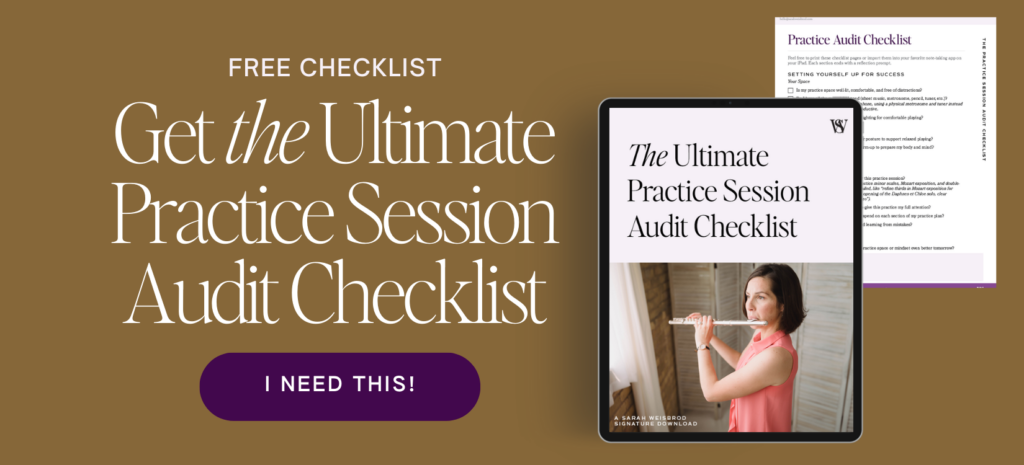
Want to make sure you never miss a thing next practice session? Then be sure to download your free copy of the Practice Audit Checklist.
1. Make a Practice Plan
Make a plan for what you want to practice. It could be incredibly detailed, breaking down exactly what you want to practice and for how long. Or it could simply be a list of what you want to accomplish.
And your practice plan doesn’t need to be anything fancy. You could write it on a post-it, in your phone’s notes app, or in a dedicated practice journal.
Just write down what you want to get done so you can have an effective practice session.
2. Set Practice Session Goals
As you’re making your practice plan, write down 3 things you need to get done in that practice session. They could be incremental goals, like “increase the tempo of this excerpt by 10 clicks,” or they could be broader, like “work on the transition into the development.”
Try to avoid writing goals that are general and vague. Not only will it be difficult for you to accomplish those in a practice session, but you’ll feel overwhelmed, too.
Creating practice goals does two things for you:
- It gives you a trackable way to ensure you’re making progress.
- As you cross off each item in your list, it gives you a nice dopamine boost.
If you’re interested in learning more about setting achievable practice goals, be sure to check out this post.
3. Set a Timer
It’s so easy to get sucked into a passage or even a piece. To stay on track during your practice session, set a timer.
You can always come back to a section. But if you have only 60 minutes to practice and 5 things to get through, spending 30 minutes on one thing makes it hard to complete the rest.
4. Audit Your Time
Track what you actually spend time practicing. Spoiler alert: if it’s a lot of “playing through” or mindless repetition instead of real problem-solving, then I encourage you to evaluate how you’re spending your practice time. That’s why having a practice plan and using a timer is so beneficial.
5. Have a Variety of Warmups
As much as you wish you could spend 45 minutes warming up, sometimes that just isn’t an option. It’s important —and necessary—to create a variety of warmups that work based on your practice window.
Have a full 3 hours? Sure, take some extra time to get a full warmup in. But if you have only a fraction of that time to practice, you need a 5-15-minute warm-up so you can get to work on what you need to accomplish.
6. Practice What You’re Not Good At
If you take away only one piece of advice from this blog post, let it be this: practice what you’re not good at.
I know it’s not fun, and it’s a lot of work. But the thing that’s likely holding you back? It’s probably the thing you don’t want to practice. The thing you always put off until tomorrow.
But if you truly want to grow and play those dream pieces, you need to practice what you’re not good at.
7. Have Multiple Ways to Learn Difficult Passages
When you have a wide array of problem-solving options for learning challenging passages and repertoire, you save time—and you build reliability. When nerves kick in, your brain doesn’t stop to analyze. It defaults to the strongest, most familiar pathways it has available.
That’s why repetition matters—but only when it’s accurate. Every time you play a passage, you’re reinforcing an execution plan. If incorrect notes have been reinforced more consistently than correct ones, that’s the plan your brain is most likely to execute when the pressure’s on.
Learning a passage in multiple, deliberate ways helps ensure that the right pathways are the ones your brain reaches for in performance.
This is a core concept I teach inside The Practice Code for Musicians, and it’s one alumni consistently point to as a turning point in their practice—especially when preparing for high-stakes performances.
8. Practice Away From Your Instrument
Optimizing your practice routine doesn’t always mean spending more time with your instrument in your hands. Some of the most effective work happens before you play a single note.
Mental run-throughs, score study, and physical gestures train your brain and body in different—but complementary—ways. They clarify what you’re aiming for so that when you return to the instrument, your playing is more focused and efficient.
Related: 5 Surprising Ways to Strengthen Technique—No Instrument Required
9. Find the Best Time to Practice
You will be the most productive when you practice at your mental peak, not when you’re fried after an 8-hour day.
Most musicians have a window when learning feels easier and concentration is sharper. That’s the best time to tackle demanding work like problem-solving or learning new passages, rather than forcing it into a convenient slot.
And your peak practice window may change as you grow. In college, I was the most productive at night, likely because that’s when I wasn’t going between classes and rehearsals. But then, when I went to grad school and was married, my peak practice time shifted to the mornings because I couldn’t keep my husband awake practicing until midnight.
10. Don’t Forget About Artistry
It’s easy to go through the motions of playing scales and drilling passages, thinking only about technique. But it’s important to remember that music is like a language, not some mechanical, robotic output. It’s meant to communicate.
As you’re practicing, bring your musicality into your woodshedding. Don’t add it on at the last minute. You need to practice phrasing, color shifts, and nuance alongside the technical work. Plus, when you understand the intent of a phrase, it often makes the technical side easier to understand and play.
At the end of the day, optimizing your practice routine isn’t about squeezing more into your schedule—it’s about being intentional with what you already have.
You don’t need a perfect routine or endless hours to make progress. You need strategies that support your focus, your nervous system, and your artistry. When those pieces align, practice stops feeling like a grind and starts feeling productive again.
Pick one or two ideas from this list and put them to work. Use them consistently, observe the results, and adjust as needed. That’s how effective practice turns into real, lasting progress.
⬇️⬇️⬇️ Don’t forget to grab your copy of the Practice Audit Checklist so you never miss a beat in your next practice session. ⬇️⬇️⬇️
+ view the comments
Paragraph
for when you're ready—
🎯 1. 60-Minute Strategy Session
Big performance, audition, or jury on the horizon? In this one-off intensive, we audit your current practice, map out a data-driven plan, and troubleshoot the spots that keep falling apart under pressure—so you walk away with a clear roadmap, not more question marks. Book your Strategy Session →
🔥 2. Practice Strategy Intensives
Ever wonder why your practice works… until it doesn’t? Inside Practice Strategy Intensives, we audit your current practice, map out a data-driven plan, and troubleshoot the spots that keep falling apart under pressure—so you walk away with a clear, sustainable roadmap that holds up under performance pressure. Learn more about Practice Strategy Intensives →
📚 3. The Practice Code for Musicians
Want a complete practice system instead of piecing tips together from Instagram? My signature course blends strategy, mindset, and artistry to show you exactly how to practice for confident, consistent performances—on stage, in the studio, and at the stand. Join the waitlist here →
✉️ 4. Stay in the loop (and in the practice room).
Not ready for a full commitment yet? Get weekly practice tips, mindset tools, and behind-the-scenes stories straight to your inbox—plus first dibs on new offers. Join the newsletter →
You deserve to have a musical toolkit that allows you to thrive. I combine my expertise as a professional flutist and software developer to give you a methodical, science-backed approach to learning even the most difficult music efficiently and effectively.
I combine it with elements of the Alexander Technique and the art of musical storytelling and interpretation to help you eliminate anxiety and perform effortlessly and with ease. Your playing matters—you have something to say, and I'm here to help you say it.

featured
Why do difficult passages sometimes fall apart in performance, even after hours of practice? In this article, you’ll learn why mindless repetition isn’t enough—and how practicing from multiple angles can help build passages that remain reliable under pressure.


GETthe COMPLETE STEP-BY-STEP GUIDE to FLUTE VIBRATO
If you're ready to achieve a natural-sounding vibrato, this is the guide for you—featuring a 5-step tutorial walking you through learning flute vibrato from scratch.
Inside you'll learn:
- How find the reaction in your sound.
- How vibrato is produced in the body.
- Why you need a flexible vibrato.
- What types of vibrato to use in your repertoire.
- How to practice vibrato.
YES, I'll TAKE THAT DOWNLOAD
hot off the digital shelf
GETthe COMPLETE STEP-BY-STEP GUIDE to FLUTE VIBRATO
MORE TO EXPLORE

My 5 Favorite Venues in Southern Tennessee

Read on the Blog
You Don't Need *This* $$$ Wedding Vendor
Read on the Blog
Let’s fix what’s not working—so you can get back to playing, teaching, and creating with confidence.
learn about flute lessons
explore coaching options
get help with your tech stack
© Sarah Weisbrod 2026. All rights reserved.
Legal | Site Credit | Photography by AMG Photography
